
How to Search Criminal Dockets
There is no single statewide trial-court docket database here. Morgan County splits its lookup tools by court. The Morgan County Court CourtView route covers county-court matters. The Common Pleas CourtView route serves felony and Common Pleas cases. CourtView labels its Case Search as supporting lookups by case number, case type, name, attorney, and ticket or citation. The landing pages do not spell out every form control. They also do not promise documents for a given case.
Use the exact number from your court papers whenever you have one. Morgan County Court local rules require that number on filings and case calls. A name search can flag a possible court file. But for an older, restricted, or uncertain record, the court and clerk remain the right fallback.
- Read the paperwork for the court name and case number, then choose County Court or Common Pleas.
- Open the matching official CourtView eServices page and select Case Search.
- Search by the disclosed route that fits the information in hand, such as case number, name, attorney, type, or citation.
- Read the dated entries as a sequence and confirm any close hearing date with the current order or court staff.
- For an official document, ask the responsible clerk rather than treating an online result as a certified copy.
Morgan County CourtView Criminal Search
Every Morgan County CourtView entry point belongs to one court. County Court keeps its own criminal docket stream. The Common Pleas portal is where General Division felony matters start. Both landing pages advertise the same search paths. Yet neither spells out required fields, filters, result columns, or document-image options. Pick the correct court first. Otherwise a no-result can mislead you. It may look like a Morgan County case lookup has nothing to show.
| Disclosed CourtView route | Useful when | Known limit |
|---|---|---|
| Case number | The number appears on a court paper or notice. | Morgan’s public number pattern was not published. |
| Name or attorney | The exact case number is unavailable. | Detailed form behavior was not exposed during inspection. |
| Case type | The court and general matter type are known. | Available type choices were not verified. |
| Ticket or citation number | The matter began in County Court with a citation. | It is not a substitute for the Common Pleas felony route. |
The Common Pleas General Division page spells out that court's felony role and its courthouse setting. That division of labor is exactly why a Morgan County criminal docket search for a felony may require the second portal.
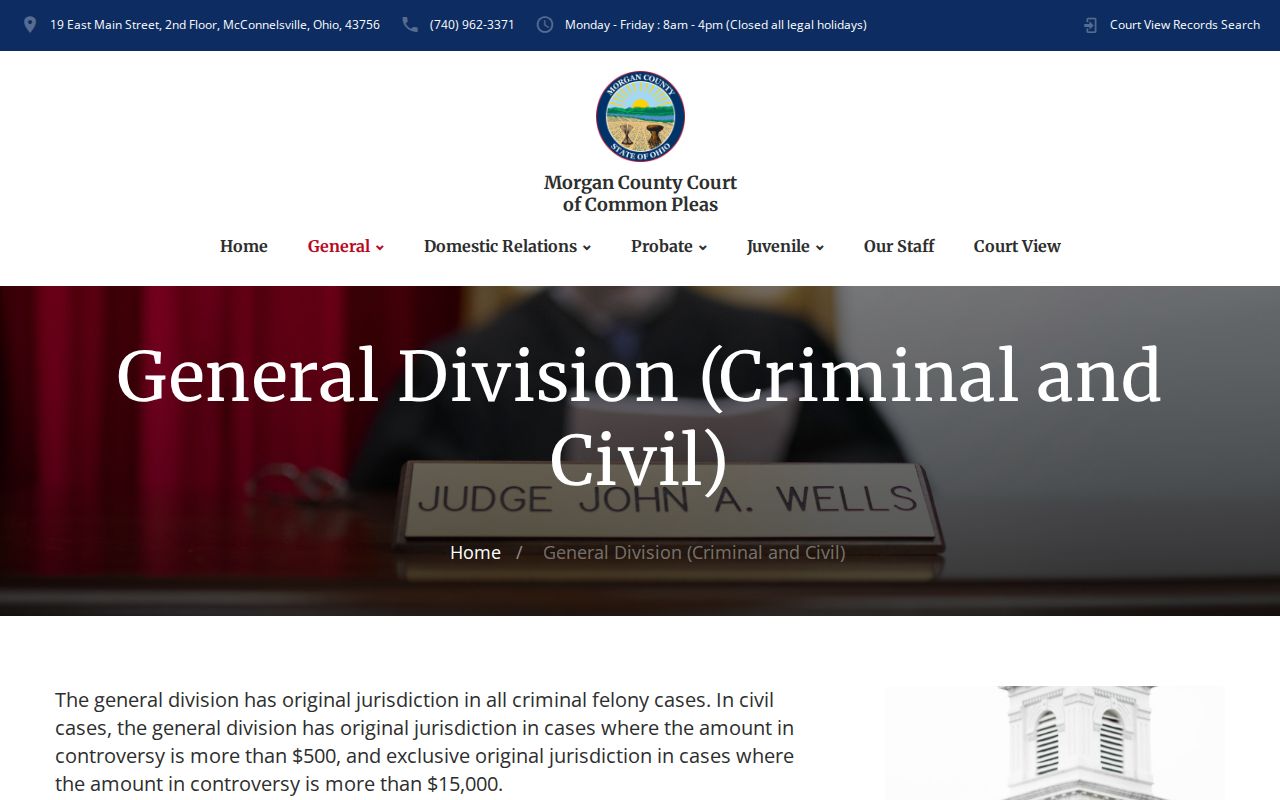
The General Division page confirms which court hears felony charges, so use that identity to steer your felony criminal docket search. County CourtView does not hold every Morgan criminal case.
Morgan County Criminal Filing Route
Morgan's CourtView landing pages advertise eFile or File Documents behind a login. The label alone does not prove electronic filing works for every criminal document, court, or division. The Common Pleas technology plan names CourtView as the docket-information system. It also discusses e-filing implementation. Universal document eligibility is another matter entirely.
Before relying on an online feature for a filing, confirm the division's current rule with the responsible clerk. The technology plan also mentions electronically signed fax filings to the Clerk of Courts. That is a plan-level practice. It is no substitute for a filed stamp or an eFile confirmation.
What a Criminal Docket Shows
Think of a criminal docket as the court's chronological register of activity. It is not a story about the case. Morgan County rules direct the clerk to docket papers without delay. Expect the basic sequence: filing, scheduled events, motions, orders, resolution, judgment, and later entries. A public CourtView result does not necessarily display charge blocks, bond data, lawyer data, balances, scanned documents, or redaction notices for every case.
| Case number | The court identifier used on filings and case calls. Use the exact number from court paperwork; Morgan has not published a verified format such as YYYY-CR-00000. |
|---|---|
| Filing or paper | A dated record that a document was submitted and docketed. |
| Setting | A scheduled event, such as an initial appearance, pretrial, status conference, hearing, trial, or sentencing. |
| Order or judgment | A court action entered in the docket. County Court criminal and traffic entries are shown as entered on the date announced by the court. |
| Disposition | The recorded outcome or procedural resolution, which should be read with the dated entry rather than inferred from a hearing title. |
Morgan County Criminal Docket Dates
Three different dates can appear in one Morgan County criminal docket entry. A filing date marks when a paper reached the clerk. A hearing date marks a scheduled court event. A journal entry or judgment date records the court's action itself. For County Court criminal and traffic matters, the local rule says judgments, orders, and entries are docketed as entered on the date the court announces. The dates relate to each other, but they are not interchangeable.
- Initial appearance
- The early criminal or traffic court event from which County Court scheduling begins.
- Preliminary hearing
- A County Court felony proceeding that is set under Criminal Rule 5 when it is not waived.
- Pretrial
- A court-directed conference after a not-guilty plea, separate from a trial or final disposition.
- Status conference
- A progress setting that Morgan County Court may conduct by telephone or in person.
- Continuance
- A postponement of a setting. Confirm the replacement date in the latest entry or order.
Note: A pretrial or status conference on the schedule is not a conviction, a sentence, or a final disposition.
Stages on a Criminal Docket
Morgan County Court's published sequence opens with an initial appearance. Under Criminal Rule 5, a nonwaived felony preliminary hearing may come next. Written motions can be set for oral hearing when appropriate. The court may also schedule a status conference by telephone or in person. After a not-guilty plea, pretrial may follow. If the case stays unresolved, it moves to court trial unless a timely jury demand shifts it to a jury schedule. Sentencing gets set as needed.
Morgan County docket flow: Initial Appearance › Preliminary Hearing When Required › Pretrial or Status Conference › Plea or Trial › Judgment Entry › Sentencing When Set
Treat this as a rule-based sequence, not a promise that every label shows up word-for-word in CourtView. The latest court order controls any individual setting.
Morgan County Criminal Pretrial Rule
Morgan County's local criminal rules set a scheduling benchmark for certain misdemeanors. The assignment commissioner schedules a pretrial for first- and second-degree misdemeanors. That pretrial comes within 30 days after initial appearance. Other misdemeanors normally head straight to trial unless the judge orders a pretrial. Remember, the 30-day rule marks a scheduling step. It is not a guaranteed finish line for the case.
When County Court orders a pretrial, the prosecutor or village solicitor, defense counsel, and the defendant must attend as ordered. Skipping a court-directed setting without just cause can carry consequences under the local rules. If you need telephone-appearance instructions, rely on the current setting order or contact court staff. No standing call-in method is published.
Morgan County Criminal Setting Contact
A date on a Morgan County criminal docket entry is only the latest word if nothing newer has been filed. The setting order or the most recent entry controls. County Court rules allow status conferences by telephone or in person, while Common Pleas technology materials treat remote appearances case by case, and neither court offers a standing public remote link for a criminal case.
Check the court named on your current paperwork for attendance instructions. Courtroom staff give telephone directions or fold them into the setting order, and a Zoom link arrives by email when that option is used.
Which Court Holds Criminal Dockets
Morgan County divides its criminal court records between two courts. Felonies belong to the Court of Common Pleas General Division. That court holds original jurisdiction over felony criminal cases. Misdemeanors land in Morgan County Court, and that court also runs preliminary hearings in felony matters. The split trips up many docket searchers. An early felony entry can sit under County Court. The trial case belongs to Common Pleas.
| Morgan court | Criminal docket role | Official access route |
|---|---|---|
| Morgan County Court | Misdemeanors, traffic matters, and nonwaived felony preliminary hearings. | County Court CourtView or the County Court Clerk at 37 East Main. |
| Court of Common Pleas General Division | Felony criminal cases and their General Division record path. | Common Pleas CourtView or the Clerk of Courts at the courthouse, 19 East Main. |
Morgan County Felony Docket Bridge
One felony can touch both Morgan courts. That does not blend them together. County Court's local rules keep a nonwaived preliminary hearing there under Criminal Rule 5. The General Division's original felony jurisdiction then supplies the Common Pleas docket path for the case. Read the case papers closely. Match the current court name before picking a clerk or portal, because a preliminary-hearing entry will not tell you what Common Pleas later did.
Certified copies follow the same split. County Court records travel the County Court Clerk route. Felony documents and certified General Division records belong to the Morgan County Clerk of Courts. CourtView can display docket information. The official court record itself stays with the clerk of the responsible court.
Morgan County Criminal Clerk Records
Start at the right counter. County Court criminal records sit with the County Court Clerk at 37 East Main. Common Pleas General Division felony records sit with the Morgan County Clerk of Courts. That office is at the courthouse, 19 East Main. The court named in the case decides the counter and the official-copy route, not the county name alone.
A precise request names the court, the case number, the approximate year, and the entry or document sought. Morgan County posts no general criminal-record mail form. No online records request form or flat copy price is published either. Confirm current requirements and turnaround directly with the responsible clerk.
Public Access and Sealed Criminal Dockets
Ohio treats court case records as public. Public does not mean every file is displayed remotely or in full. The current Rules of Superintendence permit redaction, restricted access, and generic docket descriptions when protection is warranted. Morgan County's Juvenile Division and sealed matters call for extra care. A no-result on a docket search can reflect the wrong court, a restriction, sealing, or incomplete remote history. It never proves that no court record exists.
For County Court records filed after January 1, 2006, local rules say electronic text and digital images are retained. The clerk supplies hardware for public-record review and copying. That access happens in person. It is not a promise that every document can be downloaded from CourtView. Ask the clerk how to inspect a particular public record. Ask too whether a certified copy is available.
For sealing itself, Ohio Revised Code 2953.32 sets out the official rules for sealing and expungement of eligible conviction and bail-forfeiture records.
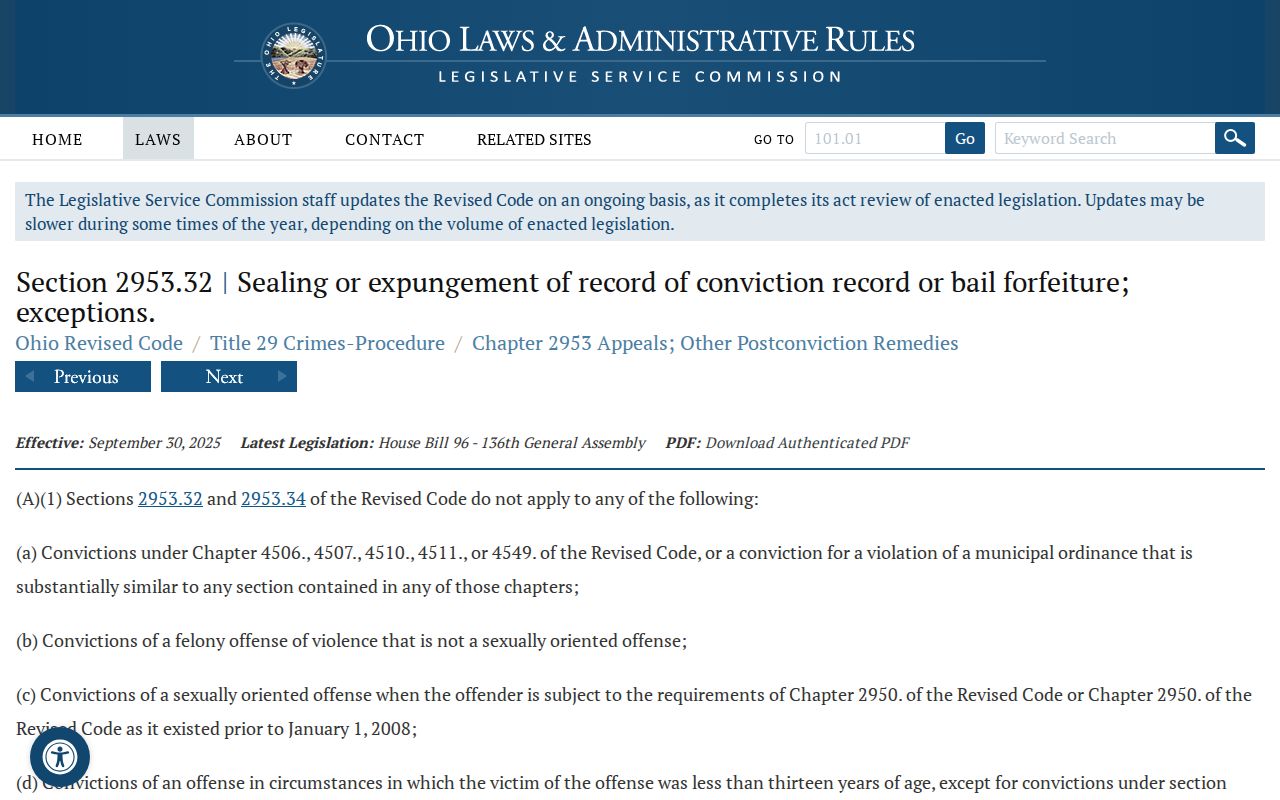
The statute draws a careful boundary. Eligibility and any public search result must be confirmed with the court itself, never assumed from what a portal happens to display.
Ohio record-access rules:
Ohio Revised Code 149.43 addresses public-record inspection and copying, while court records also follow judiciary rules.
Ohio Revised Code 2953.32 allows eligible conviction or bail-forfeiture records to be sealed or expunged under statutory conditions.
Ohio Revised Code 2953.33 provides a route for eligible not-guilty, dismissed, no-bill, or pardoned matters.
Morgan County Criminal Audio Records
A Morgan County criminal docket, an audio record, and a transcript are three different records. The docket is the written chain of filings, settings, orders, and entries. County Court proceedings are audio-electronically recorded. Wanting a transcript means arranging payment with the reporter. Local rules make that a person-to-person step, not an automatic CourtView feature. For a hearing record, ask the court or clerk which item exists and what current process applies.
Common Pleas technology materials also describe digital audio recording. Neither source promises public audio downloads, a transcript for every case, or a docket search that delivers either one. Use the docket to identify the event. Then contact the court responsible for the underlying proceeding.